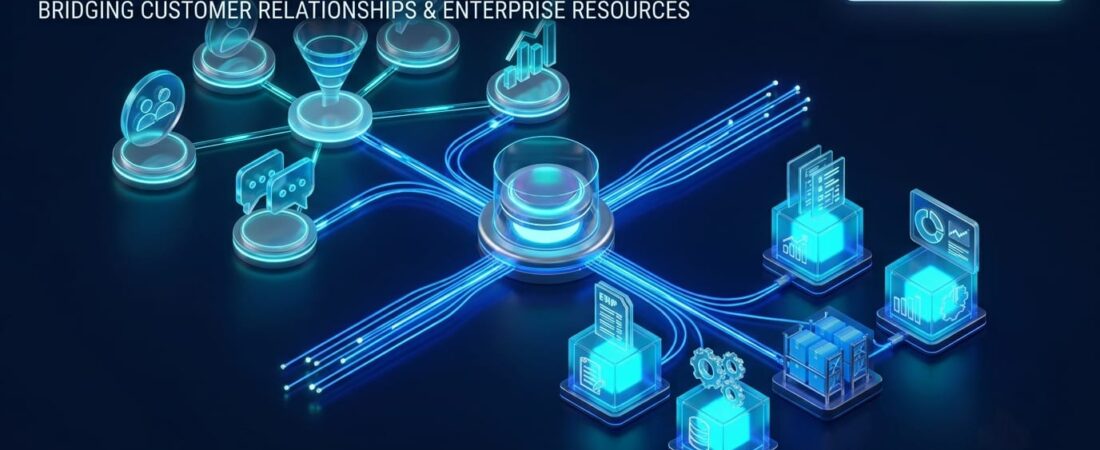
As modern businesses expand, manual record-keeping and disconnected tools quickly create operational bottlenecks. To scale efficiently, leadership teams inevitably face a critical infrastructure decision: should they implement a Customer Relationship Management (CRM) system, deploy Enterprise Resource Planning (ERP) software, or integrate both?
While both platforms serve as the digital backbone of high-growth enterprises, they serve fundamentally different operational purposes. A clear understanding of the CRM vs ERP key differences ensures your organization invests in the software architecture best aligned with its immediate pain points and long-term expansion goals.
Here is an architectural comparison of CRM and ERP software, the strategic advantages of combining them, and a decision framework to identify the right fit for your business.
What is CRM (Customer Relationship Management)?
A CRM platform manages a company’s front-office interactions across prospects, leads, and active clients. Its primary goal is driving customer acquisition, optimizing conversion rates, and maximizing customer lifetime value (LTV).
CRM platforms centralize touchpoints across sales, marketing, and customer support into an accessible profile, ensuring every representative delivers informed, contextual service.
Core Capabilities of Modern CRM Software
- Lead and Pipeline Tracking: Visual tracking of deals through custom qualification stages.
- Omnichannel Communications: Centralized logs for customer calls, emails, meeting transcripts, and live chat inquiries.
- Marketing Workflow Automation: Segmented drip sequences, campaign tracking, and lead scoring based on user activity.
- Customer Service Ticketing: Automated escalation queues, SLA monitors, and integrated knowledge bases for fast support resolutions.
What is ERP (Enterprise Resource Planning)?
If a CRM runs the front office, an ERP platform powers the back office. An ERP system orchestrates enterprise-wide resource allocation, financial governance, supply chains, and operational workflows.
Rather than maintaining separate accounting books, warehouse spreadsheets, and HR folders, an ERP connects these disciplines into a unified operational database—establishing a single source of truth for the entire business.
Core Capabilities of Modern ERP Software
- Financial Accounting: General ledger, accounts payable/receivable, automated invoicing, tax compliance, and faster quarterly reconciliations.
- Supply Chain & Inventory Management: Real-time stock counts, purchase orders, vendor management, and automated replenishment alerts.
- Manufacturing & Operations: Material requirement planning (MRP), production scheduling, and bill of materials (BOM) management.
- Human Capital Management: Employee onboarding records, payroll calculations, attendance tracking, and performance assessments.
Direct Comparison: CRM vs. ERP
| Dimension | CRM (Customer Relationship Management) | ERP (Enterprise Resource Planning) |
| Operational Focus | Front-office (Sales, Marketing, Customer Support) | Back-office (Finance, Supply Chain, Operations, HR) |
| Primary Objective | Increase top-line revenue, conversions, and retention | Reduce operational overhead, cut waste, and safeguard margins |
| Core End Users | Account executives, SDRs, marketers, support agents | Controllers, accountants, procurement managers, operations leads |
| Key Metrics | Customer Acquisition Cost (CAC), Churn Rate, Pipeline Velocity | Gross Margins, Inventory Turnover, Days Sales Outstanding (DSO) |
| Deployment Scope | Fast onboarding; focused on contact and sales pipelines | Comprehensive rollout; touches core enterprise accounting and workflows |
Strategic CRM and ERP Integration Benefits
Operating CRM and ERP systems as disconnected software silos forces teams to manually duplicate data between platforms. This disconnect creates billing discrepancies, shipment delays, and distorted sales projections.
Connecting both systems unlocks measurable CRM and ERP integration benefits that streamline cross-departmental handoffs:
1. Unified 360-Degree Operational Visibility
When a sales executive closes an enterprise deal in the CRM, an integrated ERP system automatically generates the sales order, deducts stock from inventory, and creates an accounts receivable invoice—eliminating manual re-entry.
2. Accelerated Quote-to-Cash Cycles
Without integration, finance teams must wait for sales reps to submit contract values manually. A synchronized pipeline automatically turns approved quotes into active ERP ledger entries, reducing fulfillment delays and improving cash collection speeds.
3. Inventory-Aware Sales Teams
Sales representatives can view live inventory levels directly from their CRM interface. This eliminates the risk of selling unavailable inventory or promising fulfillment timelines that the warehouse cannot meet.
4. Reliable Financial Forecasting
Combining real-time CRM sales pipeline data with historical ERP expense and procurement trends enables leadership to generate accurate predictive cash flow models.
Decision Matrix: Which System Does Your Business Need First?
- Deploy CRM First If: Your operational model has manageable supply chains or standard service deliveries, but lead conversion, pipeline visibility, and client retention need immediate optimization.
- Deploy ERP First If: Your core struggle involves inventory write-offs, delayed financial reconciliations, complex manufacturing schedules, or multi-entity accounting discrepancies.
- Deploy Both Simultaneously If: Your enterprise is migrating away from fragmented spreadsheets into custom software platforms to scale high-volume transactional operations.
Conclusion
Neither CRM nor ERP is universally superior; both represent essential software pillars for sustainable growth. A standalone CRM drives top-line revenue by refining customer interactions, while an ERP safeguards bottom-line profitability through operational and financial rigor. Modern enterprises that integrate both platforms build an automated, error-free operational bridge from initial lead capture to final balance sheet reconciliation.