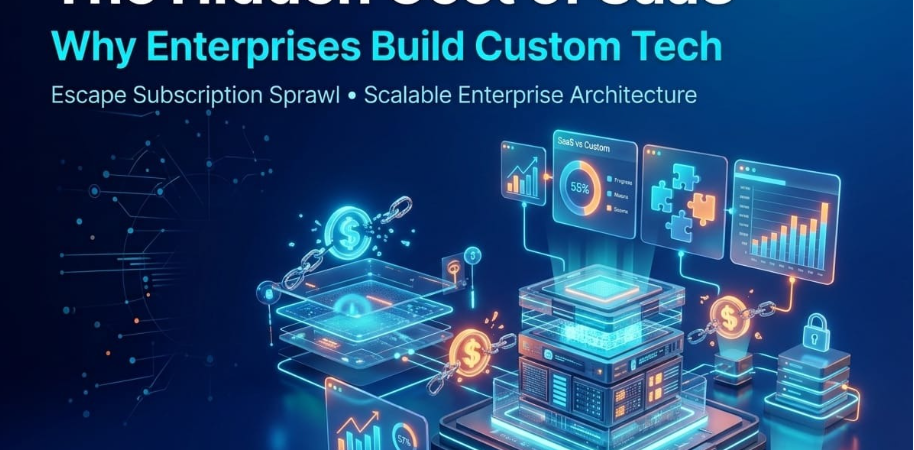
Blog Overview
When evaluating custom software vs saas, every growing company initially leans toward ready-made tools. It feels affordable, quick to set up, and hassle-free. But as operations scale, what began as a $50 monthly subscription quickly spirals into a bloated tech stack costing thousands of dollars every month.
The Illusion of Cheap SaaS: How Subscription Sprawl Happens
When a business is small, paying $25 per user per month for a CRM or a project tracker seems harmless. But scale changes the math entirely.
As teams expand across sales, operations, finance, and customer support, companies find themselves paying for dozens of disconnected SaaS tools:
- Sales uses one CRM.
- Project management runs on another platform.
- Invoicing and inventory sit in separate accounting tools.
- Communication happens across third-party chat apps.
Before long, a mid-sized team with 50 employees can easily spend between $5,000 and $15,000 every single month on seat licenses alone. This recurring expense never stops, never builds company equity, and compounds every single time you hire another team member.
The 4 Hidden Costs of Relying Entirely on Off-the-Shelf SaaS
A. The “Seat Tax” on Business Growth
With SaaS, success is penalized. The more people you hire, the more your software costs increase automatically. Businesses often end up rationing seats—giving login access to only a fraction of their staff—which creates artificial bottlenecks in communication and daily reporting.
B. The Integration Nightmare & Fragmented Data
Generic SaaS platforms are built for the average user, not your specific operational pipeline. Connecting them requires expensive third-party webhooks, Zapier integrations, or API middleware that frequently break. Employees waste hundreds of cumulative hours manually exporting CSV files, copying data between tabs, and fixing synchronization errors.
C. Feature Bloat vs. Unmet Core Needs
Most companies use barely 20% to 30% of the features packed into complex enterprise SaaS subscriptions. Yet, you pay full price for the remaining 70% of bloat you never touch—while still lacking the one or two bespoke workflows your business genuinely needs to run smoothly.
D. Vendor Lock-In and Data Fragility
When your entire database is locked inside a proprietary SaaS ecosystem, migrating away feels impossible. Subscription prices can increase by 20% to 40% year-over-year with zero recourse, leaving business leadership trapped with rising overhead costs.
Custom Software vs SaaS: Direct Financial and Operational Comparison
| Metric | Off-the-Shelf SaaS Stack | Tailored Custom Software |
| Initial Investment | Low upfront setup fee | One-time development & deployment cost |
| Long-Term Financials | Recurring, permanent seat fees that grow infinitely | Zero seat fees; predictable hosting & maintenance |
| Asset Ownership | Pure operational expense (OpEx); zero equity value | Tangible intellectual property (IP) asset on balance sheet |
| Process Alignment | Your team changes its processes to fit the tool | The software is built precisely around your workflow |
| Data Control | Shared public cloud; subject to platform policy changes | 100% owned, secure, private databases |
When Does Building Custom Internal Tools Make Financial Sense?
When analyzing custom software vs saas for enterprise infrastructure, the tipping point always comes down to compounding seat licenses and unique operational workflows.
You should consider moving to custom software if:
- Your monthly SaaS bills cross a critical threshold: If your recurring SaaS stack exceeds $2,500 to $4,000 per month, building a tailored internal tool often breaks even within 12 to 18 months.
- Your workflow gives you a competitive advantage: If your sales cycle, production floor, or inventory flow is unique, forcing it into a cookie-cutter SaaS template slows down your team.
- You manage sensitive proprietary data: When client confidentiality or regulatory compliance is non-negotiable, hosting your own architecture prevents third-party leaks.
How to Transition from SaaS Bloat to Owned Tech
Switching doesn’t mean tearing down your operational infrastructure overnight. Smart organizations take a phased approach:
- Step 1: Audit your tech stack. List every paid subscription, active user count, and actual frequency of use.
- Step 2: Identify the primary bottleneck. Consolidate the two or three disconnected tools that cause the highest manual drag (such as fragmented CRM and dispatch operations).
- Step 3: Build a focused MVP. Work with an engineering partner to build a lightweight, proprietary version of that exact workflow.
- Step 4: Scale modularly. Once the core system delivers proven ROI, expand feature sets iteratively without paying additional seat licenses.
Frequently Asked Questions (FAQ)
Q1: Isn’t custom software development too expensive compared to SaaS?
While custom software requires an initial upfront investment, it eliminates permanent monthly seat charges. Over a 3- to 5-year timeline, owning your custom system almost always costs significantly less than cumulative enterprise SaaS licensing.
Q2: How long does it typically take to deploy a custom internal tool?
Using modern agile development frameworks and modular architectures, a production-ready custom business tool or internal CRM can typically be planned, built, and deployed in 6 to 12 weeks.
Q3: Who handles maintenance and updates for custom software?
A dedicated engineering partner or an internal tech lead manages cloud hosting, security patches, and minor workflow updates, keeping long-term maintenance costs predictable and minimal.
Conclusion
SaaS platforms were designed to get companies started quickly, but they were never designed to be your permanent operational home. As your enterprise scales, renting generic software transforms from a convenience into an expensive operational bottleneck. Investing in custom enterprise software shifts your technology budget from an endless recurring expense into a permanent business asset that adapts to your growth, keeps your data private, and scales without artificial per-user penalties.